Saturday, September 3, 2011

Northern Africa

Northern Africa


As far as the North region of Africa I am including the countries of Algeria, Tunisia, Libya, and Egypt.  Northern Africa as far as languages go is similar to Northwestern Africa in that Arabic is a huge part of the area.  In fact the Arabic language is the primary language in all of the countries I classified as Northern Africa, (and I didn't look it up or anything beforehand to make it easy on myself, purely coincidence and me feeling that this is my blog and I can break up a continent any way I please).

Arabic is the sixth most used language in the world with origins in Saudi Arabia in the times even before Islam.  It is spoken by over 200 million people worldwide, with a large number of those residing in Northern Africa.  The language belongs to the Semitic language family that also includes Hebrew, Maltese, and Tigre just to name a few.  Modern Arabic is really two languages if you analyze it; the modern standard arabic and the colloquial arabic.  The difference between the two is fairly simple; the colloquial language is used when talking and in informal situations and the modern standard is used when a more formal situation calls for it.  Just as any other language there are slight variations depending on the region, (just as the eastern United States uses some different terms than the western half), but overall the modern standard arabic is universal and understood by all arabic speakers.
Arabic letters.  Another interesting thing about the language is that unlike English which is read from left to right, Arabic is read from right to left.  

The language came to the area through the Quran, which was written in the classical arabic language.  The Quran is the basic religious text of Islam and while the language was obviously alive before the printing of the text, (otherwise no one would be able to read it and it would present a host of other logistical issues), the Quran spread the language very effectively.  Just like colonization affected the region I classified as Northwestern Africa, religion affected the region and languages of North Africa.


Arabic history sources: http://www.appliedlanguage.com/translation/arabic_translation/arabic_language_history.aspx
http://linguistics.byu.edu/classes/ling450ch/reports/arabic.html

North Western Africa

The countries of north western Africa that I am including in this portion of the analysis are: Morocco, Western Sahara, Mauritania, Senegal, The Gambia, Guinea Bissau, Guinea, Sierra Leone, Liberia, Cote D'Vivoire, Ghana, Burkina Faso, Togo, Benin, Mali, and Nigeria.  The actual country lines and borders don't seem to mean much as far as languages travel but for the purpose of organization I listed them anyway.  As far as the official spoken languages in the area it is split between the classifications Afro Asiatic and Niger Congo A, with a slight grouping of Nilo Saharan in the country of Mali.
The countries I am classifying as Northwestern Africa.


Okay now to explain that in a way that actually makes sense.  The Afro Asiatic language family is one of the world's largest language families and consists of about 375 current languages.  The most common languages in this family are Arabic, variations of the Berber language, Amharic (the national language of Ethiopia), and Hausa.  Arabic is the primary language in Morocco, Western Sahara, and Mauritania.  The language is also spread along northern Africa but Mauritania is as far southwest as it officially travels.  The Berber languages are the indigenous dialects of the continent and have many branches.  In Mali the dialect Taureg is spoken for example.

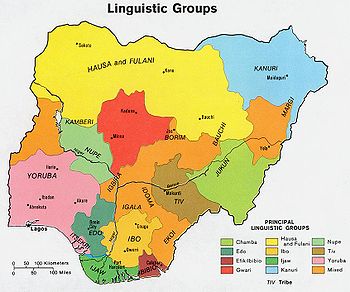
These few countries and the languages they speak are not surprising to me, but when I focused on Senegal and found its official language to be French I was caught a little more off guard. French is the language used by the administration and has the title of "official" but when it comes to usage only 15-20 percent of males understand it and only 1-2 percent of women.  Instead the most commonly used language is Wolof.  This shows that the colonization of this country long ago still has a governmental impact even though the culture and people are not the same.  Ghana and Nigeria also show this impact of past colonization.  Both countries official languages are English, though the population outside of officials does not speak this language nor understand it very well.
(ABOVE): Nigeria is just one example of an ex-colony
that may have a colonial "official" language but in
reality consists of many different dialects and
languages.
Source: http://static.howstuffworks.com/gif/willow/geography-of-mauritania0.gif

AFRICA! Or more specifically languages spoken in Africa.

I wanted to learn more about the cultures and languages spoken in such a large and diverse country and how those different languages are influenced by the geography of the area.  Each week I want to focus on a different area or country within Africa and analyze the languages the citizens speak and how those languages came to that area.  Through this exploration I hope to better understand and appreciate the diversity that exists in Africa and also to gain a deeper understanding of the continent.  I know this will be a lot of work but I am really excited to learn so wish me luck and here we go!